Specialism
Therapy for self-harm
Understanding what the harming does for you, and building something that does it instead — CBT and EMDR with a BABCP-accredited therapist, online across the UK, in English or Spanish.
If you need help urgently
Therapy is not an emergency service. I don't monitor messages between sessions, and there may be days when you can't reach me.
If you need help now:
- 999 or A&E — if you have injured yourself and need medical attention, or you are in immediate danger
- NHS 111, option 2 — for a mental health crisis, 24 hours a day
- Samaritans: 116 123 — free to call, any time, day or night
- Text SHOUT to 85258 — free, confidential text support, 24/7
Needing stitches or a check-up is not a failure and not something to be ashamed of. Please go.
Does this sound familiar?
It does something. That is the part that rarely gets said out loud, because saying it sounds like a defence of it. But people do not keep doing something that gives them nothing. It might bring relief when the feeling has got too big, or punishment when you think you deserve it, or proof that you are real when everything has gone numb, or simply a way to turn the volume down to somewhere you can stand.
Afterwards there is the hiding. Long sleeves in July. Planning where and when, and how long it will take to look like nothing. The strange split between the part of you that is horrified and the part that is already thinking about next time.
When people do find out, they tend to respond to the marks rather than to what was underneath them. They get frightened, or angry, or they ask you to promise. You promise, because you want to give them that, and then the promise becomes one more thing you have failed at.
So you stop telling people. And the self-harm becomes the one thing in your life that reliably works, which is exactly what makes it so hard to put down.
How I work with self-harm
We do not start with stopping. We start with what it does for you, because until we know that, taking it away just leaves you holding the same feeling with nothing to put against it. I have never met anyone who self-harmed for no reason, and I will not treat you as though you are the first.
The practical work is a sequence. What was happening in the hours before. The feeling, and where in the body it sat. The thought that arrived with it. The urge, and how long it lasted. What you did. What it gave you in the first ten minutes, and what it cost by the next morning. We do this with real, recent episodes rather than in the abstract, because the abstract version is always tidier than the truth.
Then we build alternatives that do the same job — the actual job, not a generic one. Something that punishes is not replaced by a warm bath. Something that produces sensation when you are dissociated is not replaced by deep breathing. We work out what yours does and find things that are honest competitors, and I will tell you plainly that the early substitutes will feel like a worse version of what works.
And we treat what is underneath. Self-harm usually sits on top of something else: trauma, depression, OCD, an eating difficulty, or circumstances that are genuinely unbearable rather than merely being thought about wrongly. Where there is trauma, EMDR is often part of it. Where the circumstances are the problem, we say so, and work on them rather than on your attitude to them.
Urges tend to get further apart before they get weaker, and weaker before they stop. Knowing that order in advance matters, because otherwise the first weeks of real progress get dismissed as nothing.
What to expect
The first session includes an honest conversation about risk — what you do, how often, how badly, and whether any of it has been about wanting to die rather than wanting to cope. I ask calmly and directly. It is not an interrogation and it does not trigger anything automatic; it is how I work out what would actually help.
I will also tell you exactly where confidentiality ends, at the start rather than when it becomes relevant. What you tell me stays between us, with the usual exception: if I believe you or a child are in immediate, serious danger, I may need to involve someone else, and wherever it is possible I do that with you rather than behind you.
There are no contracts and no ultimatums here. I will not ask you to promise to stop as the price of being helped, because that mostly teaches people to lie to their therapist. If you self-harm during therapy you can say so, and we will look at it the way we look at everything else — as information, not as a reset to zero.
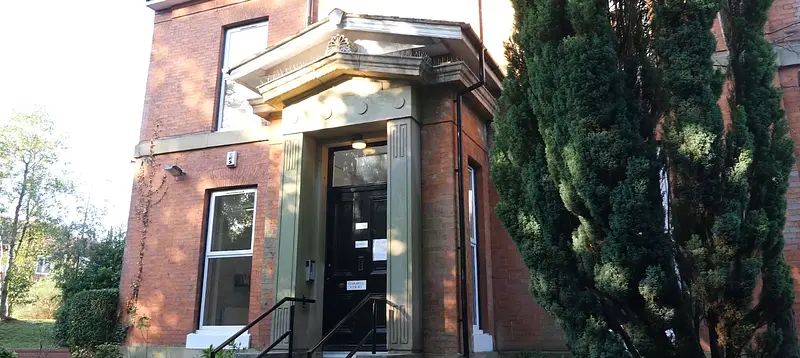
A typical course runs 12–20 weekly sessions of 50 minutes, longer where there is trauma to process. Sessions are online across the UK and worldwide, or in person at Sanctuary Therapy Centre in Prestwich and Hebden Bridge.
Common questions
Will you make me stop straight away? No. Stopping is usually the last thing that changes, not the first. What changes first is understanding the sequence well enough to interrupt it, and having something else that does the job.
Do I have to show you? No. I am not going to examine anything, and you never have to describe more than you want to. If an injury needs medical attention, that is a job for your GP or A&E, not for a therapy room.
What if I self-harm while I'm in therapy? It is common, particularly early on. Tell me, and we will use it. An episode you hide is the only one we can't learn anything from.
Will you tell my family, or my GP? Not as a matter of course. What you tell me is confidential, and the exception is immediate, serious danger to you or to a child. Where I do need to involve someone, I do it with you wherever that is possible.
Is it still self-harm if I don't cut? Yes. Burning, hitting, scratching, picking, biting, hair-pulling, swallowing things, deliberately not eating, taking risks you know are dangerous — the function is what matters, not the method.
I've done this for years. Is it too late? No. Long-standing self-harm is worked with in exactly the same way; it usually just means there is more underneath it and the work takes a little longer.
Can sessions be in Spanish? Yes — I offer therapy in English and Spanish.
Ready to take the first step?
A free 15-minute call to talk through what's going on and see whether working with Gisela feels right — no pressure, no obligation.




Send Gisela a message
A few lines about what's going on is enough — you don't need the right words for it. She reads every message herself and replies within one working day.